
I got up too early yesterday, and with a team lunch eating into my midday nap, I went to bed before ten.
A quarter of 2024 is already gone. A night of rain has added a little more melancholy to the Qingming festival (the day Chinese families tend their ancestors' graves), but I'm in Hangzhou and can't go home to put fresh earth on the old graves of my forebears. After breakfast I made a cup of coffee and sat down by the window to sort through what I've been thinking and feeling lately.
My biggest cumulative gain of the whole first quarter was finishing Scholar's Advanced Technological System (a Chinese web novel), a hardcore science-fiction novel let down by its title. The author's academic range and prose are both solid. The main thread follows Lu Zhou, an academic prodigy, through his explorations in mathematics, as he pushes physics, biochemistry, materials science, energy, information science and human civilization as a whole forward.
Some people say a few of the book's details are quite wrong. Others say that even they, as outsiders, can tell the author is fooling outsiders.
To me, the first is a normal criticism. The second is just short-sightedness; that reader might as well not have read the book.
For me, the book pushed further the process of connecting the dots between some key experiences from my past, and it gave me a framework-level understanding of the central disciplines of today's world and their central questions. That is exactly why I called it a "cumulative gain" above: accumulation presupposes some consistent main thread. For me the big thread is how far I have come in experiencing and understanding the natural world and human society. The more focused sub-threads are investing and computing. But as I said in About me, understanding the world is the bigger question, the foundation of all foundations.
Which dots got connected?
The ACM campus contest, Ah Huang's transcendental number, USTC's admissions exam, a primary-school contest
When I took part in the campus round of the ACM programming contest in college, one problem involved very large numbers, that is, numbers beyond what 32-bit or 64-bit binary can represent. You need something like the built-in long long type some languages provide. Whether a language has built-in big-number handling isn't really the point. The point is that I had no background knowledge about big numbers at all, so I designed the algorithm with ordinary integer and floating-point types. Naturally the precision wasn't enough and the results were way off.
Only later did I learn that this is "the problem of limited precision in how computers and the C language represent data". My first reaction on learning it was: "What the hell, our college C course never taught this. Isn't this problem beyond the syllabus?"
Once in high school I ran into a hard math problem and felt I had cobbled together an answer. When I discussed it with Ah Huang, a classmate sitting next to me, he glanced at my result and said: your answer is wrong, because the problem is about a polynomial with integer coefficients, and your answer has a transcendental number in it. Me: ?????
Before that, I went from my county town to Zhengzhou to sit the independent admissions exam of USTC (the University of Science and Technology of China). Almost every question on the paper involved knowledge I had never seen. Beyond the syllabus, absolutely beyond the syllabus, damn it.
An even earlier memory: in first grade I entered a competition and did terribly. Later I heard that only second or third graders, or even third and fourth graders, could have had the knowledge it required.
A flash of insight: the valley of death on the learning curve, and the point of enlightenment
At first I assumed situations like these were much the same for everyone my age: some knew a bit more, some a bit less, but no qualitative difference.
So I never dug into it, and unfortunately no one was around to point it out to me. Only after several years of work, meeting more people and seeing more things, did my horizons widen enough for me to gradually understand what it meant.
1/ The point of enlightenment in learning.
On the learning path of every skill or discipline there is a critical point on the climb, which I call a true point of enlightenment, in exactly the sense Kant meant in his essay "What Is Enlightenment?".1
Past this point, the student has walked out of the valley of death and can use their own reason to explore the much larger map still covered in fog.
Fail to get past it, and once the guidance stops, they keep circling and repeating at a low level, or even slide backwards.
2/ How to tell whether someone has reached it.
My own test is whether the student has built a small framework map out of what they already know, whether they have a vague picture of where things go from here, and whether, when they meet a suitable piece of knowledge, they can judge without anyone's help whether it fits into the map they already have and connects to it.
Only then has the master truly "led them through the door" (as the Chinese saying goes, the master leads you through the door, and the practice is up to you).
Only then do they have the foundation for taking in a high-volume flow of information.
3/ High-volume information input.
From what I later learned about the admissions results, plenty of people could indeed handle the questions that were beyond my syllabus. That was when I realized what "real teaching resources" mean, and what "material prepared for students with capacity to spare" means. The horizons of big-city teaching teams and the learning resources available there are simply not something a small county town can match, and they produced a cohort of talented students with very wide horizons. The questions that were beyond our syllabus had long been within their view. The shock I felt when Ah Huang mentioned transcendental numbers made me feel the gap deeply, and later I found many students like Ah Huang among my college classmates.
When I was at Liulou Primary School, my family didn't own a single book outside the textbooks. I coveted the school's little library room, but it was never opened to students before I graduated. In fourth grade I worked up the courage to ask the headmaster if I could borrow a book. He said all he had was Marx's Capital. I said Capital would do. He said even he couldn't understand that book, and didn't take me seriously. In the end I never borrowed a single book.
Going to middle school in the county town was painful but the right thing. With money I saved I bought Sherlock Holmes and Science Fiction World (a Chinese science-fiction magazine), and was lucky enough to pick up some popular-science magazines at a stall selling miscellaneous books. Sherlock Holmes and Science Fiction World in particular still have a very visible influence on me today.
Of course, back then nobody sold advanced reading for the main academic track. The only advanced book I read in high school was Chen Yuezeng's General Biology, borrowed from Ah Huang, and it influenced me a lot too.
Come to think of it, it makes sense. Having never been exposed to any of that, how could I possibly answer those questions by transferring knowledge?
When the difficulty in front of you lies too far beyond your knowledge and horizons, the gap is hard to cross. Besides, some knowledge simply cannot be derived from more basic knowledge. You can't work out integration on the spot in an exam hall from basic arithmetic.
4/ Drop the idea of "beyond the syllabus" entirely.
Perhaps this is what competitions are for. They tell contestants that there is no syllabus in any absolute sense in this world, and therefore no such thing as "beyond the syllabus". They demand that contestants broaden their horizons, recognize that a bigger picture exists, accumulate, lift the fog covering the areas humanity has already explored bit by bit, and then explore the edges of the picture.
For people with plenty of life experience this is easier to grasp. No one is going to draw a boundary around the problems you face in real life and promise you'll find the answer as long as you search inside it.
And to let go of this idea and look for solutions across a wider range, building a vague but global framework matters most of all.
Columbus and the maps of the Age of Discovery
Before the Age of Discovery, European maps mixed science, speculation and theology. They covered only the known world of Europe, parts of Asia and the northern coast of Africa, and their accuracy varied enormously. Take, for example, the world map drawn in the late 15th century by the cartographer Henricus Martellus Germanus 2:
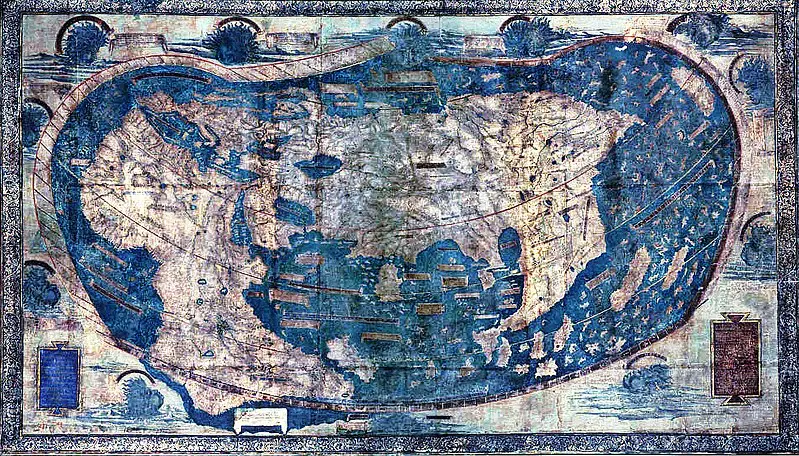
Columbus, a navigator of the same late 15th century, relied early on precisely these error-ridden maps. The Age of Discovery he went on to open fundamentally changed mapmaking: as explorers returned from new lands, cartographers folded the new information into their maps, vastly extending the reach of world maps and improving their accuracy.
In hindsight, those early maps, full of holes as they were, gave people a macro framework of the world and a precious sense of finiteness. That finiteness and framework gave the courageous pioneers more confidence to explore the whole world and to look for new sea routes, and that exploration would in turn correct the errors and make both the framework and the details more precise.
A map full of errors is far better than no map at all
If you can meet or find a teacher, textbook, novel, article or any other means that suits you and gives you a top-down framework map, please don't miss it, and certainly don't give up such a precious opportunity just because someone says it has a few small mistakes.
- Kant's essay is well worth reading. A Chinese translation is available at: http://www.personpsy.org/uploadfiles/file/opentheeyes/culture/2020/什么是启蒙康德.pdf ↩
- See the Wikipedia entry: https://en.wikipedia.org/wiki/Henricus_Martellus_Germanus ↩
We meet by chance in this world.
I’m XingHua — glad to meet you.